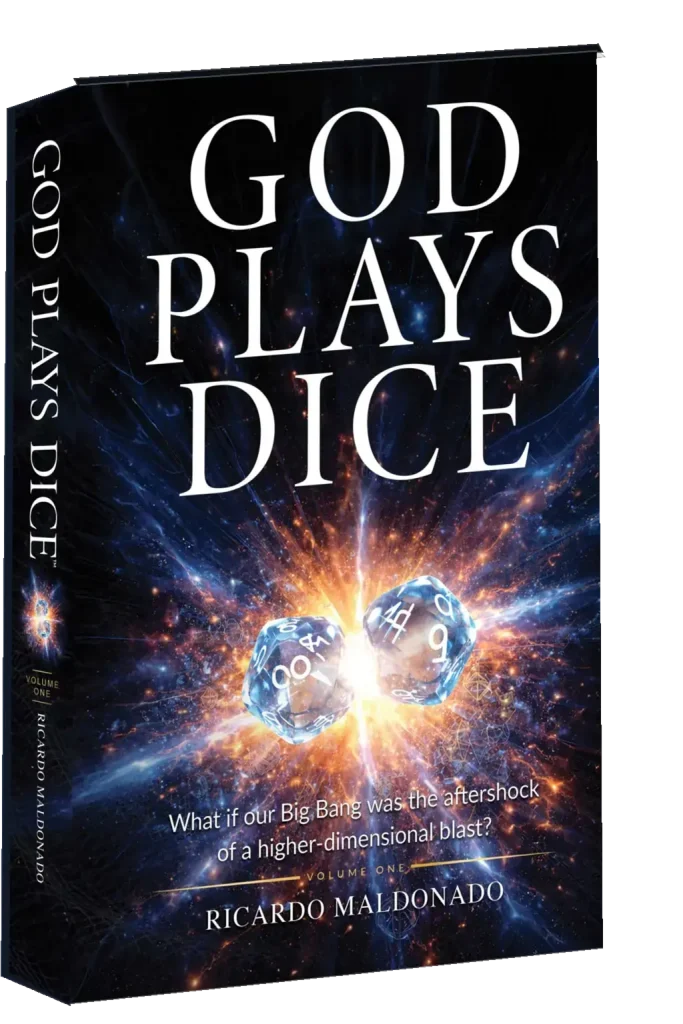


INSIDE VOLUME ONE
02 / THE JOURNEYTwelve chapters.
One restless question.
From the personal origin of the idea to a public scorecard, each chapter keeps a testable proposal separate from proof.
- 01
When the Night Wouldn’t Let Me Sleep
From childhood cosmic questions to the sleepless night when a physical picture formed, this chapter traces the personal path behind the hypothesis while keeping biography separate from evidence.
- 02
The Question That Wouldn’t Shut Off
The Big Bang model’s triumphs meet the deeper question of initial conditions, and the higher-dimensional “d-blast” becomes a picture with a possible gravitational-wave target—not proof.
- 03
How to Listen to the Universe
A plain-language tour of gravitational waves, LIGO, LISA, pulsars, and the galaxy-sized detector built from cosmic clocks explains what a persistent bend could—and could not—tell us.
- 04
The Knee in the Noise
The idea becomes a frozen five-parameter benchmark in the pulsar-timing band, with a clearly defined knee and guardrails that make the proposal testable.
- 05
The Line I Will Not Cross
The book separates its central claim from unfinished particle-physics directions and sets a hard condition: late-time gravity must still pass the tests of four-dimensional general relativity.
- 06
When Black Holes Ring Like Bells
Black-hole ringdown becomes a demanding check, illustrated by a pipeline whose real observational conclusions remain reserved for real-event posteriors and full systematic analysis.
- 07
How We’ll Know
A four-rung evidence ladder distinguishes model definition, exploratory screening, conditional consistency, and the real-data trials that remain open.
- 08
Where the Blast Lives
Branes, the bulk, and possible higher-dimensional events enter the picture—along with the warning that a viable model must derive its source, coupling, spectrum, energy budget, and cosmic evolution.
- 09
How to Watch the Dice Roll
A practical guide to future headlines separates a common signal, a persistent feature, a favored source family, and a fully derived mechanism while asking whether analyses are truly independent.
- 10
Meaning in a Dice-Playing Universe
The story turns from measurement to meaning without letting philosophy replace evidence: the benchmark may be alive, but it is not proved.
- 11
How Science Kills and Crowns Ideas
Corrections, version history, stronger data, rival explanations, and independent attempts to break an idea become the standards by which it earns—or loses—seriousness.
- 12
If the Dice Really Fell This Way
The final chapter asks what would change if every gate were passed—and why derivation, alternatives, replication, peer review, and repeated observation would still matter.