Skip to content
BackGOD PLAYS DICE™Big questions, honest answers

THE QUESTION LIBRARY GOD & BELIEF

Why do I still feel fear or guilt after I stopped believing?

Feelings learned over years can outlast the beliefs that shaped them, so here is what research shows, why it happens, and what helps, whether you leave, stay or return.

If this is personal right now: call 988 or text 988 in the US · more support

THE SHORT ANSWER

Most likely because feelings learned over years can outlast the beliefs that taught them. A person can believe that flying is safe and still fear it, and old religious fear and guilt may work the same way. Lab studies show that when a learned fear fades, the old learning is not erased, so it can flare up again later or in a different setting. Time, safe new experiences, supportive company and, when needed, counseling can help.
  • Emotions can resist reason: the Stanford Encyclopedia of Philosophy notes that many people do not believe flying is dangerous, yet still fear it.
  • In lab research, a fear that fades is not erased; new learning is added on top, and the old fear can return with time or in a new setting.
  • Studies in the United States, the Netherlands, New Zealand and Hong Kong found that formerly religious people still somewhat resembled religious people in some attitudes and habits.
  • In interviews with 18 people in Finland who had left religious groups they experienced as highly demanding, living with fear and guilt was a main theme, and so was a life of freedom and joy.
  • Scrupulosity, a form of OCD focused on sin and morality, can affect believers and nonbelievers, and it can be treated.
On this page
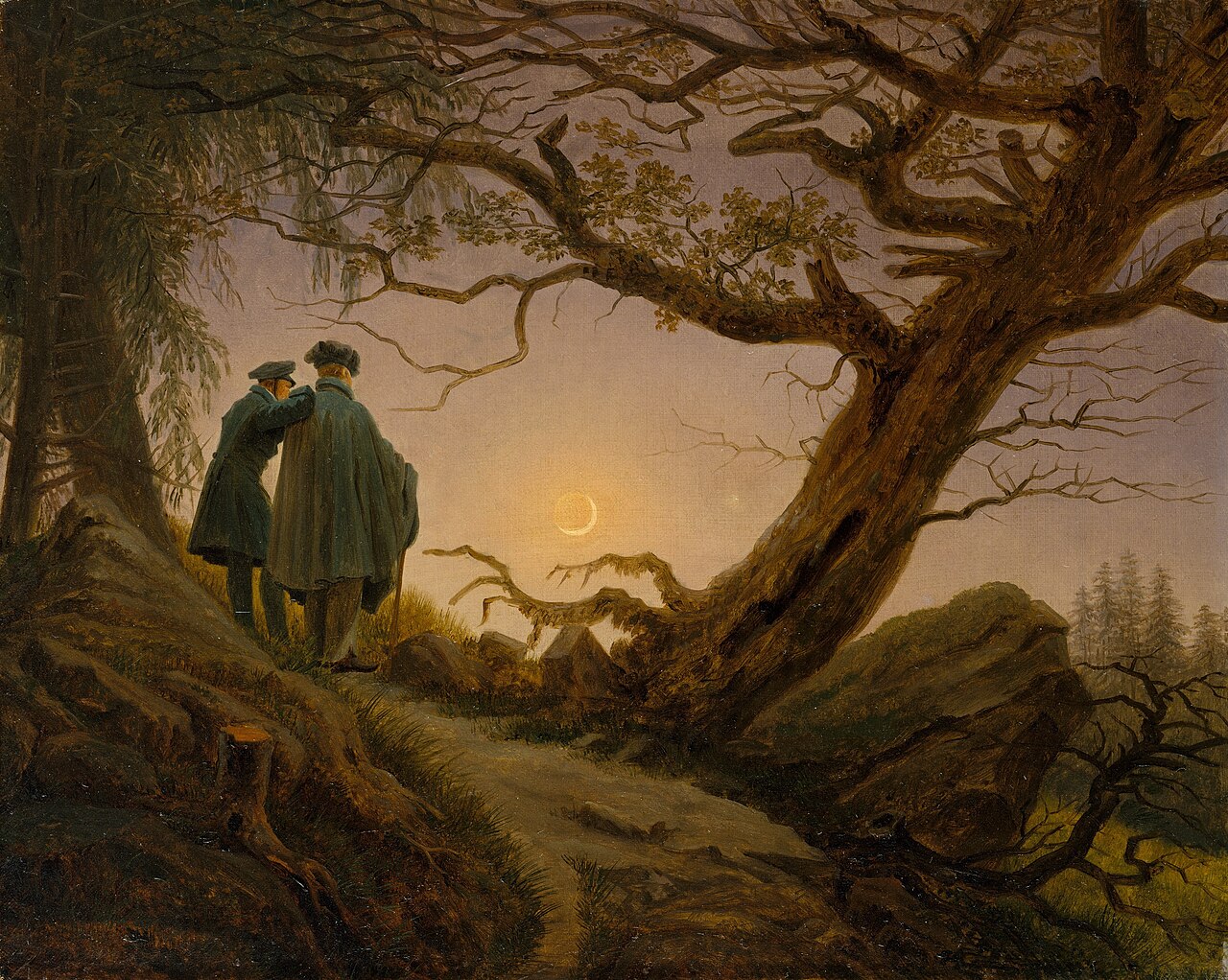
An oil painting of two men in long coats and caps, seen from behind on a rocky slope at dusk. One rests a hand on the other’s shoulder as they look at a thin crescent moon through the twisting branches of a large tree.
About this picture

Caspar David Friedrich painted Two Men Contemplating the Moon in about 1825–30: two companions at dusk, one with a hand on the other’s shoulder. Studies of people who leave a faith suggest that good company matters.

Caspar David Friedrich, Two Men Contemplating the Moon (about 1825–30), The Metropolitan Museum of Art, via Wikimedia Commons · Public domain · Image source ↗

WHERE THE EVIDENCE STANDS

How sure are we?

  • A learned fear can fade without being erased, and it can return later or in a different setting.Reviews of lab research in animals and people: extinction does not destroy the original learning but adds new learning that is especially tied to context (Bouton, 2004); conditioned fears are easy to extinguish but recover easily (Vervliet, Craske and Hermans, 2013); fear can return with the passage of time or after a change of setting (Craske and colleagues, 2014). This research is not about religion.
  • People who stop identifying as religious tend to keep some religious attitudes and habits.Van Tongeren and colleagues (2021): three studies with national samples in the United States, the Netherlands, Hong Kong and New Zealand found a religious residue in attitudes toward God, religious practice and giving, and (in New Zealand) volunteering. The studies come from one research team and did not measure fear or guilt.
  • People who leave religious groups they experienced as highly demanding can carry lasting fear and guilt.Björkmark, Nynäs and Koskinen (2022): in-depth interviews with 18 people in Finland; fear of having sinned, of punishment and of hell, and deep guilt, formed a main theme, alongside freedom and joy. The researchers sought out people who had struggled after leaving, mostly through a support organization, so the study cannot show how common these feelings are.
  • About a third of U.S. adults have experienced religious trauma.One survey of 1,581 U.S. adults (Slade and colleagues, 2023) estimated 27 to 33%, based mainly on people’s own answers about whether they fit the study’s definition (27.7% said yes). The study was funded and run by the Global Center for Religious Research and appeared in a journal from the same center, and the paper itself says the term has been ambiguously defined in much of the research literature.
  • You should leave your faith, or you should stay in it.Research can describe these feelings and what helps with them. It cannot say what anyone should believe, or whether a lingering feeling carries a religious meaning. Support exists on every path, from secular therapists and peer groups to clergy who welcome questions.
What the labels mean

WHAT WE DON’T KNOW YET

How many people feel fear or guilt after leaving a faith, and for how long, is not yet known. A 2021 review of research on leaving religion called for more long-term studies that follow people over time, and for more attention to differences between cultures and religions.

WHAT WOULD CHANGE THIS ANSWER

A study that directly tests whether old religious fears behave like other learned fears would support or overturn the key link on this page. Long-term studies that follow people of many faiths as they leave, stay or return could show how often these feelings last and what helps most. So could an agreed definition of religious trauma, tested in careful, independent surveys.

Most likely because feelings learned over years can outlast the beliefs that shaped them. You can change your mind in a season. The fear and guilt you learned over years, often since childhood, may take longer to catch up. That does not make you weak, and it does not show that your old beliefs were true or false. A feeling is not a verdict.

People come to this question in different ways. Some no longer believe in hell but still feel a jolt of fear about it. Some feel that an illness or a hard stretch is God punishing them. Some still pray just in case. And some find that freedom, though wonderful, can be frightening at first. An interview study and OCD specialists describe all of these.

Here is the core picture. Scientists who study fear have found that when a learned fear fades, the old learning is not erased. A new lesson, that the thing is safe, is added on top, and that new lesson is tied to the setting where it was learned. So an old fear can come back with time, or in a different place. Philosophers of emotion describe a related pattern in daily life: many people do not believe flying is dangerous, yet still fear it.

Research on people who leave a faith fits this picture, though it is still thin. Studies in the United States, the Netherlands, New Zealand and Hong Kong found that formerly religious people keep some religious attitudes and habits. In interviews, people who had left religious groups they experienced as highly demanding described fear and guilt, and also freedom and joy.

What helps? Time, safe new experiences, supportive company, and counseling when the feelings get heavy. This page will not tell you whether to leave, stay or return. That part is yours. If fear or guilt ever turns into thoughts of hurting yourself, please reach out now: in the U.S., call or text 988, and our care page lists more help.

THE LONG ANSWER

Why can feelings outlast beliefs?

The Stanford Encyclopedia of Philosophy notes that emotions often resist reason: many people do not believe flying is dangerous, yet they keep fearing it.

Research on fear suggests how this can happen. In the classic lab model of fear learning, a neutral picture is followed by an electric shock, and after several pairings the picture alone brings fear. If the picture keeps appearing with no shock, the fear fades. This fading is called extinction. But lab research reviewed by Mark Bouton in 2004 shows that extinction does not destroy the original learning. It adds new learning, and that new learning is closely tied to its setting.

That is why fear can come back. A review by Michelle Craske and colleagues describes how fear can creep back as time passes, or return when the old trigger shows up in a setting different from the one where the fear faded. Another review put it plainly: learning that something is safe is fairly easy; remembering it is harder (Vervliet, Craske and Hermans, 2013).

We found no study that tests this link directly in former believers, so treat it as a reasonable inference, not a finding. But it fits what some former members describe: fears that continued after they left.

What do studies of people who leave a faith find?

Daryl Van Tongeren and colleagues studied formerly religious people using national samples from the United States, the Netherlands, Hong Kong and New Zealand. Across three studies, formerly religious people differed from people who had never been religious, and somewhat resembled religious people, in attitudes toward God, religious practice, giving and, in New Zealand, volunteering. The authors call this a religious residue. In two studies, formerly and currently religious people also held more negative attitudes toward God than people who had never been religious. The authors note that identities tend to change slowly, which can leave people between two groups: no longer religious, but not like those who never were. Fear and guilt were not measured.

Maria Björkmark and colleagues talked with 18 people in Finland who had left religious groups they experienced as highly demanding. Living with fear and guilt was one of five main themes. People described fear of having sinned, of punishment and of hell, and guilt that was hard to shake after years of feeling unworthy. Yet a life of freedom and joy was also a main theme, and leaving was described as one of the biggest and most satisfying decisions in life. The study is small, and the researchers sought out people who had struggled after leaving, mostly through a Finnish support organization, so it shows what the experience can be like, not how common it is.

Leaving can also cost community. Using U.S. survey data from 1973 to 2012, Andrew Fenelon and Sabrina Danielsen found that people raised in a religion who later claimed none reported poorer health and lower well-being than people who stayed, and than people raised without religion. Overall, the gap disappeared once they accounted for how often people attended services, which the authors read as a loss of social support. For former evangelicals, a smaller well-being gap remained; the authors suggest leaving may reduce spiritual ways of coping and stir worry about sin, divine punishment or guilt. The data are a snapshot, so they cannot show cause.

What is the strongest objection?

Some clinicians and researchers argue that, for some people, lasting fear is more than old learning: it is a sign of real harm, which they call religious trauma. A survey of 1,581 U.S. adults, published in 2023 by Darren Slade and colleagues, estimated that about a third of U.S. adults (27 to 33%) have experienced religious trauma. But the estimate rests mainly on self-reports: 27.7% said yes when asked whether they believed they had experienced religious trauma as the study defined it. The study was funded and run by the Global Center for Religious Research and appeared in the center’s own journal. The paper itself says the term has been ambiguously defined in much of the research literature, and it mentions writers who dispute how common religious trauma is. So the numbers remain an open question. What is not in doubt: some people carry real pain after leaving.

A different caution matters for people of faith: not every religious worry is a disorder. The International OCD Foundation’s page for faith leaders notes that a spiritual struggle does not in itself mean someone needs mental health treatment. And whether lingering guilt carries a religious meaning, such as conscience or a call to return, is a question of faith that science cannot settle.

This page’s own explanation has a weak spot too: the fear research comes mostly from labs and does not test guilt, and the residue studies measured neither fear nor guilt. That is why the page carries the label Supported, still debated.

What helps, and when is it time to get help?

Give it time, and expect ups and downs. In fear research, safe new experiences add a new lesson, and old fear can still flare up now and then. People in the Finnish study described moving back and forth between freedom and fear at first; once people regain their footing, the researchers write, life takes a new, positive direction. A flare-up is not failure.

Find your people. Research cited by Fenelon and Danielsen suggests the social benefits of attending come mostly from friendships around services and from activities such as volunteering. In the Finnish study, finding new relationships seemed to play a vital role in building a new life. Recovering from Religion, a nonprofit for people dealing with doubt or non-belief, offers a peer support line (844-368-2848), chat, and more than 50 peer support groups, many of them online.

Consider counseling. If fear or guilt takes up much of your time, causes great distress, or gets in the way of daily life and relationships, talk with a licensed therapist. Recovering from Religion’s Secular Therapy Project connects people with licensed therapists who offer evidence-based, non-religious care. Many in the Finnish study had benefited from psychotherapy.

Know the signs of scrupulosity. Scrupulosity is a form of obsessive-compulsive disorder (OCD) focused on sin and morality: excessive worry about sin, blasphemy or hell, with repeated acts meant to relieve it, such as excessive praying, confessing or seeking reassurance. The International OCD Foundation notes that atheists and agnostics can have it too, since no one can be completely sure of any belief, including disbelief. It also notes that Martin Luther and Ignatius of Loyola struggled with it. A 2010 review found little evidence that religion itself raises the risk of OCD. The main psychological treatment is a form of cognitive behavioral therapy called exposure and response prevention.

If you are staying or returning. A clergy member who welcomes questions can be a good ally. Many people with OCD turn to a spiritual leader first, the foundation notes, and leaders can help steer them toward appropriate treatment. Scrupulosity therapy may also include advice from leaders of the person’s own tradition.

If it gets heavy. Some people in the Finnish study described times when death felt easier than living with their pain. If you ever feel that way, please reach out now: in the U.S., call or text 988. Our care page lists more help, and our answers on questioning what you were raised to believe and on telling family about your doubts may help too.

Where can people of faith and skeptics agree?

  • A life ruled by dread helps no one. Faith traditions speak to this in their own terms. The First Letter of John says that “perfect love drives out fear,” linking fear with punishment (1 John 4:18). In the Quran, God tells His servants who have gone too far against their own souls not to lose hope in His mercy (Quran 39:53), a verse the commentator Ibn Kathir reads as a call to all sinners to repent and turn to God. Whether God exists and forgives is beyond science.
  • Feelings deserve care, not shame. OCD specialists write that OCD is not a moral compass anyone ought to follow, and treatment can help whether a person believes or not.
  • Support should fit the person. Nobody should be pushed toward one path.

How can you check this yourself?

  • Ask who was studied. A national survey describes a population; interviews with 18 people describe what an experience can be like.
  • Look for the definition. When you see a number for religious trauma, check how the term was defined and who decided whether people fit it.
  • Read the scrupulosity fact sheet. The International OCD Foundation’s two-page fact sheet lists common signs and treatments.

The answer stays the same. Fear and guilt can outlast belief, most likely because feelings learned over years change more slowly than minds do. They can ease with time, company and care, and you do not have to face them alone.

Deep dive (optional)

Three ways an old fear comes back. Lab researchers describe several ways a faded fear returns, each showing that at least part of the original learning is still there (Craske and colleagues, 2014). In spontaneous recovery, fear creeps back as time passes after it faded. In renewal, fear returns when the setting changes from the one where it faded. In reinstatement, fear returns if the unpleasant event happens again on its own, without the warning signal. The same review lists ways therapists try to make the new learning last, such as practicing in more than one setting and putting feelings into words.

A caution about the leap from lab to life. These findings come from controlled studies of learned fear, often with simple signals such as pictures and shocks. Religious fear and guilt are richer: they involve ideas, relationships and identity. The lab findings suggest why old feelings can linger, but they do not measure religious fear or guilt directly.

THREE THINGS TO REMEMBER

  1. Feelings learned over years can outlast a change in belief; a feeling is not a verdict.
  2. Old fears can fade with safe experience but may flare up again, and a flare-up is not failure.
  3. Help exists on every path: peer groups, therapists, and clergy who welcome questions.

More answers for hard days

Next on the path “What if the answers I was given stopped fitting?”

Can You Be Good Without God?

Most Americans now say you don't need God to be moral, though views differ sharply around the world. The harder question is what makes goodness real, and there…

Beyond scienceRead the full story

Words worth knowing (6)
Extinction
In psychology, the fading of a learned fear when the feared signal keeps appearing with nothing bad following. Research shows it adds new learning rather than erasing the old.
Religious residue
The name researchers gave to their finding that people who stop identifying as religious tend to keep some religious attitudes and habits.
Scrupulosity
A form of obsessive-compulsive disorder (OCD) focused on religious or moral worries, such as fear of having sinned, often with repeated acts like excessive praying or confessing.
Exposure and response prevention (ERP)
A type of cognitive behavioral therapy in which a person gradually faces what triggers their fear or worry without doing the usual compulsion, the repeated act meant to relieve it.
Religious trauma
A term some clinicians and researchers use for lasting harm to a person’s well-being from religious events, relationships or circumstances that felt overwhelming. Definitions still vary, and so do estimates of how common it is.
Disaffiliation
Leaving the religious tradition you were raised in for no religious affiliation.

Sources & further reading

(10) · Checked Sep 29, 2026
  1. Emotion (Andrea Scarantino and Ronald de Sousa) ↗Stanford Encyclopedia of Philosophy (first published 2018)Section 10.1: emotions are often recalcitrant to reason: “many people do not believe that flying is dangerous, and yet continue to fear it”. Section 5 lists, among standard critiques of judgmentalism, the “recalcitrance to reason” some emotions display when they are not extinguished by judgments that contradict them, as when someone judges that flying is not dangerous but continues to be afraid of it.
  2. Maximizing Exposure Therapy: An Inhibitory Learning Approach ↗Behaviour Research and Therapy 58 (2014): 10–23, Michelle G. Craske, Michael Treanor, Chris Conway, Tomislav Zbozinek and Bram Vervliet; doi:10.1016/j.brat.2014.04.006Pavlovian model: a neutral stimulus (such as a neutral picture) followed by an aversive stimulus (such as an electric shock); after a number of pairings the neutral stimulus elicits fear; although fear subsides in extinction, retention of at least part of the original association can be uncovered; spontaneous recovery (fear grows with time since extinction; parallels the return of fear that commonly occurs after exposure therapy); renewal (fear returns if the context changes between extinction and retest); reinstatement (unsignaled aversive events between extinction and retest); exposure therapy is an effective approach for anxiety disorders, although a substantial number fail to benefit or experience a return of fear; strategies include multiple contexts and affect labeling. Related reviews (PubMed abstracts): Mark E. Bouton, Learning & Memory 11 (2004): 485–494, doi:10.1101/lm.78804 (extinction does not destroy the original learning but generates new learning that is especially context-dependent); Vervliet, Craske and Hermans, Annual Review of Clinical Psychology 9 (2013): 215–248, doi:10.1146/annurev-clinpsy-050212-185542 (conditioned fears are easy to extinguish but recover easily; extinction is relatively easy to “learn” but difficult to “remember”).
  3. Religious residue: Cross-cultural evidence that religious psychology and behavior persist following deidentification ↗Journal of Personality and Social Psychology 120(2) (2021): 484–503, Daryl R. Van Tongeren, C. Nathan DeWall, Zhansheng Chen, Chris G. Sibley and Joseph BulbuliaPubMed abstract (PMID 32162932): three studies with nationally representative samples from the United States, the Netherlands, Hong Kong and New Zealand; formerly religious “dones” differed from never religious and currently religious individuals; Study 3 found that people who deidentified were still relatively likely to volunteer. Full text read in the authors’ corrected pre-publication copy posted on PsyArXiv (https://doi.org/10.31234/osf.io/fsujg): formerly religious people differ from never religious people, “somewhat resembling currently religious individuals”, in attitudes toward God and religion, certainty and commitment, religious practices, prosocial inclinations and charitable donation; in Studies 1 and 2, current and formerly religious people reported more negative attitudes toward God than never religious people; in Study 2 (United States, Netherlands, Hong Kong), formerly religious people donated more than never religious people, but currently religious people volunteered more time than either group, so the volunteering residue comes from Study 3 (New Zealand); identity may be difficult to change and change is usually gradual; people may be left in a psychological “no-one’s land”. The measures did not include fear or guilt. The APA page blocks scripted requests.
  4. “Living Between Two Different Worlds”: Experiences of Leaving a High-Cost Religious Group ↗Journal of Religion and Health 61 (2022): 4721–4737, Maria Björkmark, Peter Nynäs and Camilla Koskinen (open access; published online Aug. 17, 2021)In-depth interviews with 18 people who had left groups they perceived as high-cost religious groups in Finland (the most demanding, theologically and culturally exclusive groups, with high participation and restrictions on behaviour and social interactions); recruitment among people who had experienced difficulties after leaving, mainly through the organization Support for Victims of Religions; five themes: living with fear and guilt, sorrow and pain over what one has lost, broken as a human being, lifelong process of building a new identity, a life of freedom and joy; fears that they had sinned, of punishment and of going to hell; guilt hard to get rid of after years of feeling a sinner and unworthy; some felt punished by God with illness or other difficulties; freedom wonderful but at first frightening, and a movement back and forth between freedom and fear; leaving one of the biggest and most satisfying decisions in life; some had suicidal thoughts; finding new relationships seems to play a vital role; conclusion: eventually, when one gains one’s “foothold” again, life takes on a new, positive direction; few studies have comprehensively explored how disaffiliation affects people’s lives; many had sought and benefitted from psychotherapy; generalization not possible.
  5. Leaving my religion: Understanding the relationship between religious disaffiliation, health, and well-being ↗Social Science Research 57 (2016): 49–62, Andrew Fenelon and Sabrina Danielsen; doi:10.1016/j.ssresearch.2016.01.007Pooled General Social Survey samples 1973–2012 (34,565 adults); disaffiliation = leaving the tradition one was raised in for no affiliation; disaffiliates report poorer health and lower well-being than the consistently affiliated and the consistently unaffiliated; the overall disadvantage is completely mediated by frequency of attendance, framed as loss of social support; for Evangelical disaffiliates a smaller well-being disadvantage remains after adjusting for attendance, which the authors take as some evidence for the spiritual aspects of religion (OR 1.54 before and 1.22 after adjusting, p = 0.02), suggesting disaffiliation may reduce resources for emotional coping and raise preoccupation with sin, divine retribution or guilt; citing earlier work, most social-tie benefits come from friendship networks around attendance and from secular activities such as volunteering; limitation: cross-sectional data cannot support causal statements. Related (PubMed abstract): Streib, Current Opinion in Psychology 40 (2021): 139–144, doi:10.1016/j.copsyc.2020.09.007 (deconversion review; calls for focusing decisively on longitudinal assessment and accounting for cultural and religious differences).
  6. Percentage of U.S. Adults Suffering from Religious Trauma: A Sociological Study ↗SHERM Journal 5(1) (2023), Darren M. Slade, Adrianna Smell, Elizabeth Wilson and Rebekah Drumsta; doi:10.33929/sherm.2023.vol5.no1.01Abstract and the journal’s public 10-page preview PDF: data from 1,581 U.S. adults; likely around one-third (27–33%) of U.S. adults have experienced religious trauma (conclusion: “based on the definition above”); 10–15% currently suffer; the study was “funded and carried out by the Global Center for Religious Research (GCRR)”; “religious trauma” “has remained ambiguously defined in much of the peer-reviewed literature”; footnote 2 cites Wilcox and Peterson’s claim that few people suffer trauma from religion in childhood; the lead author serves as President of GCRR; the journal site footer reads “© 2019‒Present by the Global Center for Religious Research”. Public data tables (https://www.shermjournal.org/_files/ugd/7caee9_b168bb1830d7470694059df585d9b998.pdf): “Do you believe you have experienced religious trauma (based on the definition above)?” Yes 438 (27.7%) of 1,581. The study’s definition, as posted on GCRR’s religious-trauma page (Internet Archive snapshot of Aug. 17, 2026): religious trauma results from events, relationships or circumstances within or connected to religious beliefs, practices or structures, experienced as overwhelming or disruptive, with lasting adverse effects on physical, mental, social, emotional or spiritual well-being. The DOI now redirects to a GCRR page that returns 404, so the article page is the source URL.
  7. OCD and faith: What if I’m Not Religious?; For Faith Leaders; Scrupulosity fact sheet ↗International OCD Foundation (IOCDF)What if I’m Not Religious? (Patrick McGrath and Zachary Appenzeller): atheists, agnostics and secularists can have scrupulosity; no one can be 100% confident in any belief; some nonbelievers with scrupulosity pray to every deity they have heard of in case they are wrong. For Faith Leaders (https://iocdf.org/faith-ocd/for-faith-leaders/, Caitlin Claggett Woods): scrupulosity is a subtype of OCD involving religious or moral obsessions; OCD is diagnosed when obsessions and compulsions become extremely time-consuming, cause significant distress and interfere with daily functioning and relationships; having a spiritual struggle does not inherently mean someone needs treatment through a mental health provider; many people with OCD seek counsel from spiritual leaders first; leaders can help steer them toward appropriate treatment. Fact sheet (https://iocdf.org/wp-content/uploads/2014/10/IOCDF-Scrupulosity-Fact-Sheet.pdf, C. Alec Pollard, 2010): obsessions about blasphemy, sin and going to hell; compulsions such as excessive trips to confession, reassurance seeking and excessive praying; notable religious leaders including St. Ignatius Loyola and Martin Luther struggled with it; CBT featuring exposure and response prevention is the primary psychological treatment; treatment may include consultation from leaders of the patient’s faith tradition. Moral Scrupulosity (Appenzeller and McGrath): OCD is not a moral compass that anyone ought to follow. Related peer-reviewed review (PubMed abstract): Greenberg and Huppert, Current Psychiatry Reports 12 (2010): 282–289, doi:10.1007/s11920-010-0127-5 (the earliest descriptions of OCD were religious; scrupulosity a classic version of OCD; evidence that religion increases the risk of developing OCD is scarce).
  8. Recovering from Religion ↗Recovering from Religion (501(c)(3) nonprofit)Mission: hope, healing and support for those struggling with issues of doubt and non-belief; peer support line 84-I-Doubt-It (844-368-2848), shown on the home page on Sept. 29, 2026, plus web calls, text chat and scheduled conversations; over 50 peer support groups around the world, many virtual; the Secular Therapy Project connects people with licensed therapists who provide evidence-based, non-religious treatment.
  9. 1 John, chapter 4 (New American Bible, Revised Edition) ↗United States Conference of Catholic BishopsVerse 18: “There is no fear in love, but perfect love drives out fear because fear has to do with punishment, and so one who fears is not yet perfect in love.”
  10. Quran 39:53 (Surah Az-Zumar), translation by Dr. Mustafa Khattab, The Clear Quran ↗Quran.comVerse 53: God’s servants “who have exceeded the limits against their souls” are told not to lose hope in God’s mercy, for God forgives all sins. Tafsir Ibn Kathir (abridged) on the same page: the verse is a call to all sinners to repent and turn to God. Verse 54, read in context, calls them to turn to their Lord in repentance before the punishment comes; the page cites only verse 53.

See a mistake? Report a problem. Corrections are made openly.

Search the Question Library

149 answers to read · 0 questions awaiting answers Your search runs on your device.

Answers about death, grief and crisis are always free, in full. If a question is personal right now →