God & BeliefAnswer
Why do bad things happen to good people?
Science can explain how many bad things happen but not the deepest why, so here is what believers, skeptics and researchers each bring to one of the oldest hard questions.
THE QUESTION LIBRARY GOD & BELIEF
Many believers live with questions and many stay in their faith, so here is what research says about telling family, how to make the talk kinder, and how to stay safe.
If this is personal right now: call 988 or text 988 in the US · more support
Gently, safely and at your own pace. Start with one person you trust, at a calm moment. Begin with what has not changed, such as your love and the values you share. Speak about your own questions, not about their beliefs, and listen to their worries. Doubt does not decide where you end up: many believers are not fully sure and still keep their faith. If telling could put you at risk, wait and get support first.
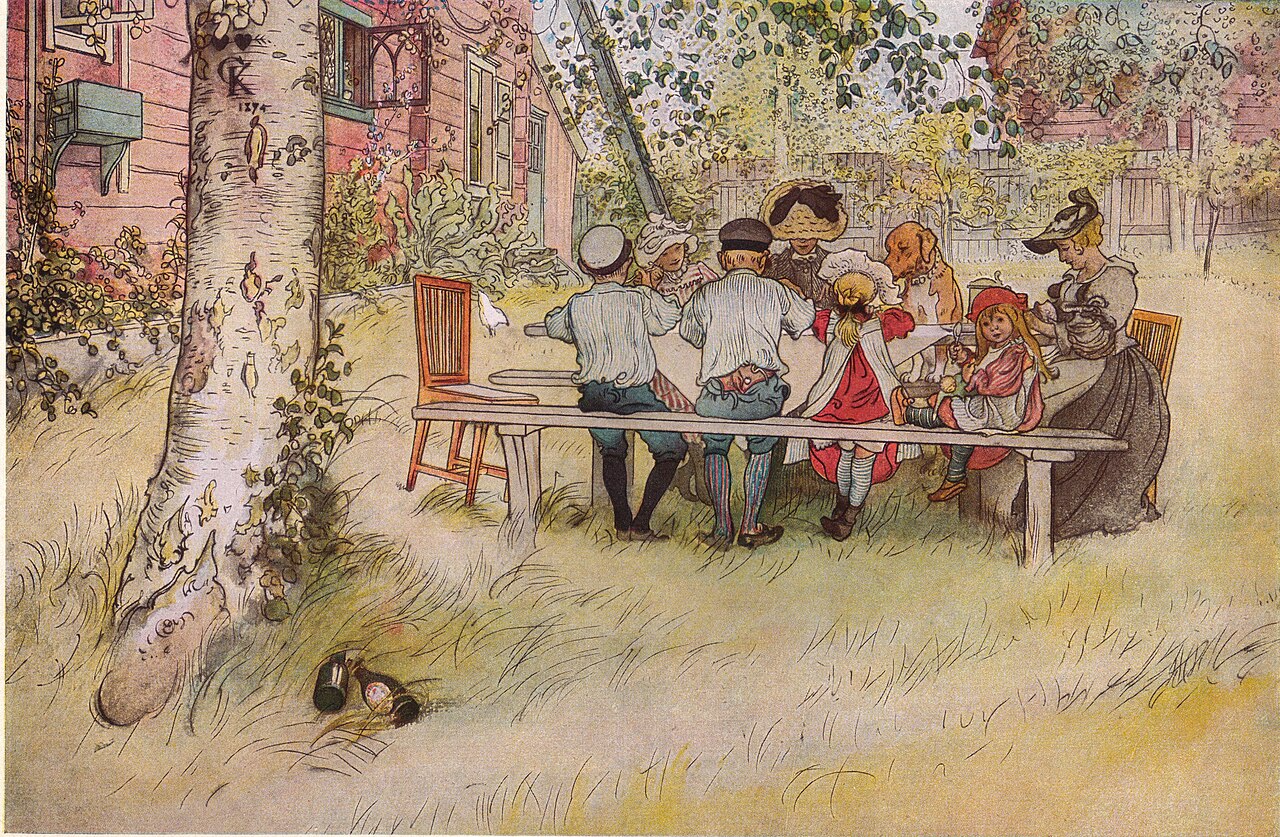
Carl Larsson’s watercolour Breakfast under the Big Birch (1896) shows a family meal in a Swedish garden. Many families share a table while holding different beliefs: in Pew’s 2023–24 study, 26% of married U.S. adults had a spouse with a different religious identity.
WHERE THE EVIDENCE STANDS
WHAT WE DON’T KNOW YET
Little research follows believers who share their doubts with family and then stay in their faith. Most studies here looked at other groups, such as atheists, older adults or voters. Nobody can predict how one family will react.
WHAT WOULD CHANGE THIS ANSWER
Long-term studies of doubting believers and their families, across many faiths and countries, could confirm or change these tips. So could trials that compare different ways of having the talk.
Gently, safely and at your own pace. There is no single right script, but some steps make the talk kinder: start with one person you trust, choose a calm moment, begin with what has not changed, and speak about your own questions rather than about their beliefs. This page will not tell you where your questions should lead. That part is yours.
First, a fact that may ease the fear: doubt is common, even among believers. In the Pew Research Center’s 2023–24 Religious Landscape Study, 83% of U.S. adults said they believe in God or a universal spirit, but only 54% held that belief with absolute certainty. Most Americans, 56%, still identify with the religion they grew up with. Having questions is not the same as having left.
Why does telling family feel so hard? Faith is often woven into family life: holidays, meals, weddings, and the hopes parents hold for their children. A believing parent may hear your doubts as a danger to someone they love. You may fear letting them down, or losing your place at the table.
Research on this exact moment is thin, but it offers clues. People who told family they no longer believed described a mix of reactions: support, anger, grief and, often, slow change over time. Experiments on hard talks about other topics suggest that swapping personal stories, without judging, works better than arguments alone.
Safety comes first. If you are young, depend on your family for a home or money, or have reason to fear harm, it is fine to wait and get support before you say anything. You do not owe anyone a conversation that could put you at risk.
Below you will find what the surveys show, what helps a talk go well, and where to find support, whether you want to stay in your faith, leave it, or simply keep asking.
Common, if doubt means being less than fully sure. Pew’s 2023–24 Religious Landscape Study, a survey of 36,908 U.S. adults, found that 83% believe in God or a universal spirit. Only 54% said they hold that belief with absolute certainty. Among Christians, 97% believe in God, and 73% hold that belief with absolute certainty. That means roughly one Christian in four believes in God without being absolutely sure.
Most people also stay. In the same study, 56% of U.S. adults still identified with the religion they were raised in, while 35% had a different religious identity. In a follow-up survey of 8,937 adults in May 2025, the reasons that people who stayed most often called extremely or very important were that they believe the religion’s teachings (64%), that it meets their spiritual needs (61%) and that it gives their life meaning (56%).
What do people often get wrong? One mistake is to treat doubt as a final decision. Telling your family “I have questions” is not the same as announcing that you are leaving. Another mistake is to think that people who leave religion stop believing in anything. Even among religiously unaffiliated Americans, Pew found that more than half believe in God or a universal spirit. Our answer on questioning what you were raised to believe looks at what several scriptures say about honest doubt, and our guide to atheists, agnostics and “nones” explains those labels.
We found little research on believers who share their doubts with family and then stay. In 2015, one study called research on people who tell family they no longer believe “still relatively sparse,” but those stories offer clues.
In that 2015 study, researchers interviewed 80 U.S. atheists about “coming out” as atheists and looked at what happened when they told close family. Most described words or actions that supported the relationship. Some parents simply said they would love their child no matter what. For other families, religion was a non-issue. Relatives often needed time to adjust. Others met anger, rejection or tears. Some were told it was a phase, pressured to attend services, or asked not to talk about it. Some relatives were in despair because they feared for the person’s eternal fate. One man had not talked with his wife about his changing views, and she felt blindsided when he told her. The group was small, and half were interviewed in Colorado, mostly at atheist gatherings, so the study cannot tell us how common each reaction is.
Hiding doubts can carry costs too. A 2009 study that followed older adults over time found that people who had more negative run-ins with fellow members of their congregation had more doubts, and were more likely to push those doubts down. Suppressing doubt was linked with less favorable health. People who attended Bible study groups were more likely to respond to doubt by seeking spiritual growth. These are links; they do not show that one thing causes the other.
Many people also say they handle religious disagreement calmly. In a Pew survey reported in 2016, about two-thirds of Baby Boomers, Gen Xers and Millennials, and 62% of the Silent Generation, said the best response when someone disagrees with them about religion is to try to understand the other person’s views and agree to disagree. Only 10% of evangelical Protestants, and 4% of atheists and agnostics, said they try to change the other person’s mind. That survey asked about disagreement in general, not about a relative’s doubts.
No study has tested a script for this exact talk. The ideas below draw on the research above and on studies of hard talks about other topics.
Two lines of research sit behind the third and sixth tips. The first is about values. Researchers Geoffrey Cohen and David Sherman reviewed studies of self-affirmation, an exercise in which people typically write about their core personal values. Their review says that threats to a person’s sense of self stir up stress and defensiveness, and that timely self-affirmation can ease them. The link to family talks is an analogy, and it has limits. In those studies, the person under threat affirmed their own values, and the outcomes were mostly about school, health and relationships. Reminding your family of values you still share is similar in spirit, but nobody has tested it. Results also vary: a large 2017 school replication found no evidence of an effect.
The second is about stories. Researchers Joshua Kalla and David Broockman ran three field experiments in which 230 canvassers talked with 6,869 voters in seven U.S. locations about unauthorized immigrants and transgender people. In the first experiment, arguments alone had no effect, while talks that also included a non-judgmental exchange of personal stories reduced exclusionary attitudes (prejudice toward a group and opposition to policies that help it) a little, for at least four months. The other two experiments found similar small effects. This is another analogy with limits. Those were canvassers talking with voters about political topics, and the talks were designed to change attitudes. At home, your goal is to be understood, not to change anyone’s faith.
Some people ask whether it is kinder to keep doubts private, to spare a parent pain or keep the peace. That can be a wise choice for a while, especially if you are unsure where your questions lead or if speaking up is unsafe. In the 2015 study, some people found that limiting or avoiding talk about religion helped protect family ties. Silence has costs too: a change discovered late can blindside someone you love, and in one study of older adults, suppressing doubt was linked with less favorable health. There is no deadline. Only you can weigh the timing.
For some people, this talk can be unsafe. If you are under 18, or you depend on family for a home, money or legal papers, think carefully about timing. It is fine to wait until you are more independent. If anyone threatens or hurts you, call 911 or your local emergency number. If you are a young person in the U.S., the Childhelp National Child Abuse Hotline has counselors available 24/7; you can call or text 1-800-422-4453.
In some countries the risk is also legal. Pew found that in 2019, 22 of the 198 countries and territories it studied had laws against apostasy, the act of abandoning one’s faith. Most were in the Middle East and North Africa, and penalties vary by country.
Support exists on every path. Recovering from Religion, a nonprofit for people dealing with doubt or non-belief, offers peer support by phone and chat, more than 50 peer support groups, and referrals to licensed secular therapists through its Secular Therapy Project. If you hope to stay in your faith, a clergy member who welcomes questions, or a counselor who shares your faith, may help. The ACPE Psychotherapy Commission, formerly the American Association of Pastoral Counselors, is a multi-faith community of professionals, and ACPE keeps a public directory of therapists. If you feel hopeless or unsafe, please use the crisis line on this page or visit our care page.
Go gently, stay safe, lead with love, and remember that doubt does not decide where you end up. You can keep asking and keep caring for your family at the same time.
THREE THINGS TO REMEMBER
Next on the path “What if the answers I was given stopped fitting?”
Why do I still feel fear or guilt after I stopped believing?
Most likely because feelings learned over years can outlast the beliefs that taught them.
See a mistake? Report a problem. Corrections are made openly.
CONTINUE THE THREAD
God & BeliefAnswer
Science can explain how many bad things happen but not the deepest why, so here is what believers, skeptics and researchers each bring to one of the oldest hard questions.
God & BeliefAnswer
Feelings learned over years can outlast the beliefs that shaped them, so here is what research shows, why it happens, and what helps, whether you leave, stay or return.
God & BeliefAnswer
Doubt is common among people who stay in their faith and people who leave it, so here is what surveys, scriptures and research say, and how to talk about it at home.
Labels describe the evidence for a claim, not the people who hold it.
Match my phone uses your device’s light or dark setting.